In FP&A, it’s easy to get buried in metrics. But one number that consistently brings clarity to long-term planning is Compound Annual Revenue Growth (CARG).
CARG helps cut through year-on-year noise by showing how revenue is truly trending over time. In volatile markets, it forces the business to review what external factors impact its revenue growth.
What is CAGR? Why Does It Matter for Business Growth?
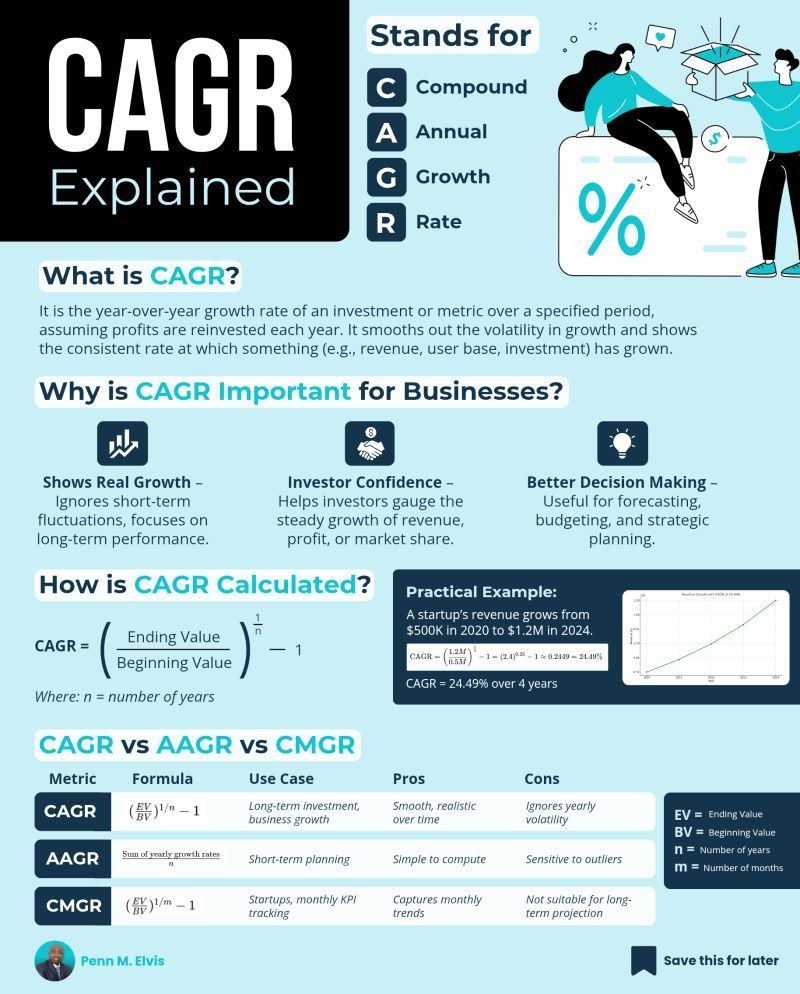
➡️ What is CAGR?
CAGR (Compound Annual Growth Rate) is the year-on-year growth rate of an investment over a specified period, assuming profits are reinvested each year.
It smooths out the volatility in growth and shows the consistent rate at which something (e.g., revenue, investment) has grown.
➡️ Why is CAGR Important for Businesses?
1. Shows Real Growth: It ignores short-term fluctuations and focuses on long-term performance.
2. Investor Confidence: It helps investors gauge the steady growth of revenue, profit, or market share.
3. Better Decision Making: It’s useful for forecasting, budgeting, and strategic planning.
4. Performance Benchmarking: It compares growth across different companies, sectors, or timeframes.
➡️ How is CAGR calculated?
CAGR = (End Value/Start Value)^(1/Number of Years) – 1
Where n = number of years
➡️ Practical Example
A startup’s revenue grows from $500K in 2020 to $1.2M in 2024. What is the CARG rate over 4 years
CARG = (1.2M/0.5M)^(1/4) – 1
= 0.2449
= 24.49%
📌 𝐋𝐢𝐤𝐞, 𝐂𝐨𝐦𝐦𝐞𝐧𝐭 & 𝐑𝐞𝐩𝐨𝐬𝐭. Share the knowledge.